
When a boiler breaks down, one of the first questions homeowners ask is:
"Is it worth repairing, or am I throwing good money after bad?"
There isn't a single answer. A ten-year-old boiler doesn't automatically need replaced, and a relatively new boiler isn't automatically worth repairing.
The sensible decision comes down to the condition of the boiler, the fault, the cost of the repair and how reliable the system has been up until now.
At Altura Heating, we'd rather look at the whole picture than tell someone they need a new boiler simply because their existing one has developed a fault.
If your boiler has developed a fault, our boiler repair service in Glasgow can help identify the problem and establish whether a repair is worthwile.
HOW OLD IS YOUR BOILER?
Age is a useful starting point, but it shouldn't be the only deciding factor.
If your boiler is less than around 8–10 years old, has generally been reliable and parts are readily available, repairing it will often make sense.
Once boilers start getting into the 10–15+ year range, replacement becomes more worth considering — particularly if you're already experiencing repeated breakdowns.
That doesn't mean a 12-year-old boiler should automatically be replaced. My own boiler is 18 years old and still going strong, although I have replaced a few parts over the years.
If it needs a relatively inexpensive component and everything else is in good condition, repairing it could still give you several more years of service.
The important question isn't:
"How old is it?"
It's:
"How much money am I likely to put into this boiler over the next few years?"
HOW EXPENSIVE IS THE REPAIR?
There's a big difference between replacing a relatively inexpensive sensor and replacing a major component.
Common boiler faults can involve components such as:
• Ignition electrodes
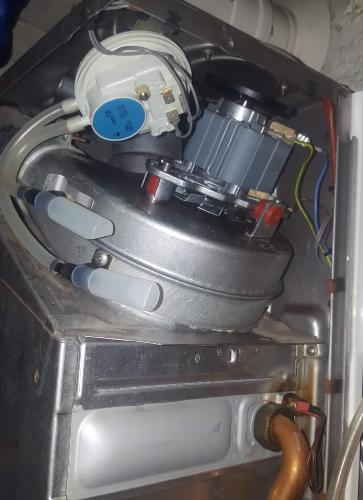
• Fans
• Pumps
• Diverter valves
• Printed circuit boards
• Gas valves
• Heat exchangers
The decision becomes more difficult when an older boiler requires one of its more expensive components.
For example, spending several hundred pounds repairing an otherwise reliable boiler may be perfectly reasonable.
Spending a substantial amount repairing a boiler that has already broken down three times in two years is a different story.
At that point, the money may be better put towards a replacement.
HAS THE BOILER BEEN UNRELIABLE?
This is one of the biggest factors we consider.
One breakdown doesn't necessarily mean anything.
Repeated breakdowns do.
If you've already replaced several components and another expensive fault appears, there's a risk of getting trapped in a cycle:
£200 repair → £300 repair → £150 repair → another breakdown.
Eventually you've spent a significant proportion of the cost of a new boiler while still owning the old one.
Keeping a simple record of what you've spent on repairs over the previous two or three years can make the decision much easier.
WILL A NEW BOILER DRAMATICALLY REDUCE MY GAS BILL?
This needs a sensible answer because replacing a boiler isn't automatically going to slash your heating costs.
If you're replacing a very old, inefficient non-condensing boiler, the improvement can be significant.
If you're replacing a relatively modern condensing boiler that's already operating efficiently, the difference may be much smaller.
And the boiler itself is only part of the equation.
How efficiently a heating system operates is also affected by:
• Heating controls
• Boiler flow temperature
• System balancing
• Radiator sizing
• Insulation
• Hot-water usage
• How the boiler is commissioned and set up
A correctly selected and commissioned boiler operating with good controls can perform very differently from the same boiler installed badly.
That's why we don't believe choosing a boiler should simply come down to buying the biggest kW output available.
BIGGER ISN'T ALWAYS BETTER
One of the most common misconceptions with boilers is that a larger boiler will heat your house better.
For most homes, that's not how it works.
A modern combi boiler may have a high maximum output because it needs that power to produce hot water quickly at the taps and shower.
Your radiators may require considerably less.
A good installation therefore isn't just about physically replacing one boiler with another. The appliance should be selected and commissioned appropriately for the property and heating system.
Correct setup can help the boiler run for longer periods at lower temperatures rather than constantly switching on and off.
That's particularly important with modern condensing boilers.
DON'T FORGET ABOUT THE REST OF THE HEATING SYSTEM
If you're replacing an older boiler, it's worth looking beyond the appliance itself.
A new boiler connected to a dirty or poorly performing heating system won't solve every problem.
Depending on the condition of the system, we may look at things such as:
• System water quality
• Magnetic contamination
• Radiator performance
• Heating controls
• Pump operation
• System balancing
• Flow and return temperatures
• Existing pipework
The goal shouldn't simply be to install a shiny new boiler.
It should be to leave you with a heating system that works properly.
WHEN WOULD WE USUALLY RECOMMEND REPAIRING?
Repair will often make sense when:
• The boiler has previously been reliable
• The repair cost is reasonable
• Replacement parts are readily available
• The boiler isn't excessively old
• There are no signs of several other components beginning to fail
• You're otherwise happy with the heating and hot-water performance
There is no reason to replace a perfectly serviceable boiler unnecessarily.
WHEN WOULD WE START CONSIDERING REPLACEMENT?
Replacement becomes more attractive when:
• The boiler is getting towards the end of its expected service life
• Breakdowns are becoming frequent
• Major components are failing
• Parts are obsolete, expensive or difficult to obtain
• You've already spent substantial amounts repairing it
• The boiler isn't providing the hot-water performance you need
• You're planning other heating-system improvements anyway
It can also make financial sense to replace a struggling boiler before it finally dies in the middle of winter, when you're under pressure to make a decision quickly.
REPAIR OR REPLACE? GET THE NUMBERS FIRST
If you're unsure, don't assume that a breakdown automatically means you need a new boiler.
Get the fault diagnosed properly and find out what repairing it will actually cost.
You can then compare:
Cost of repair + likely future reliability
against
Cost of replacement + warranty + expected service life
That's a much better way of making the decision.
THINKING ABOUT REPLACING YOUR BOILER?
Altura Heating installs gas boilers throughout Glasgow and surrounding areas.
If you already know that replacement is likely, you can use our online boiler estimate tool to get an indication of the cost before arranging a survey.
And if you're unsure whether your existing boiler is worth saving, we can diagnose the problem first and give you the information you need to make an informed decision.

